
Past exhibition
Bourdelle: The Memory of Objects
From 3 April 2024 to 18 August 2024 ️
Free admission

The exhibition “Bourdelle: The Memory of Objects” - presented in the Portzamparc Wing - offers an unprecedented immersion into the art and life of the sculptor Antoine Bourdelle (1861–1929), through a dialogue between his works and the personal objects that inspired them.
In 2020, the historic building of the Musée Bourdelle was vacated in preparation for restoration works. During this process, a large number of objects that had belonged to Antoine Bourdelle were rediscovered; who lived and worked in these premises for most of his life.
Why were these objects carefully preserved by Bourdelle, then by his descendants, and finally bequeathed to the museum? What do they tell us about life in the studio, about the artist himself, his origins, his tastes, and of course his work?
What we know today about these objects is the result of years of research, based on the careful cross-referencing of photographs, archival documents, Bourdelle’s writings, and contemporary press articles. The significance of these often modest objects lies in what they tell about the life and work of the artist. As souvenirs, even relics, they contribute through their display to the sacralization of the great man. For the most part previously unseen, these objects constitute the guiding thread of the exhibition. Through their power of evocation, they provide keys to understanding the work and art of Bourdelle.
General Curator
Ophélie Ferlier Bouat, Chief Curator of Heritage, Director of Musée Bourdelle
Scientific Curator
Valérie Montalbetti Kervella, Sculpture and Bourdelle Collections
Claire Boisserolles, Archives, Library and Documentation, Associate Curator
Scenography : Scenografia | Graphic Design : Igor Devernay
“Bourdelle: The Memory of Objects” follows the exhibition of the same name at the Musée Ingres Bourdelle in Montauban (7 July – 12 November 2023), co-organised by the Musée Bourdelle and the Musée Ingres Bourdelle.


The son of a cabinetmaker
Born in Montauban (Tarn-et-Garonne), Bourdelle frequently refers to his regional and family origins in his writings, drawings, and interviews with journalists. He likes to emphasize what his art and personality owe to his roots and to his “elders.”
The artist demonstrates deep devotion to his father, a cabinetmaker.
From him, he learns the importance of structure, a sense of construction, and the subordination of details to the overall effect: principles that would become fundamental to his sculpture.
In 1886, despite his limited resources, the young Bourdelle brought his parents to Paris. His mother soon dies. His father continues working as a cabinetmaker in a shop facing the street, currently located at number 16. The workbench, tools, miniature chest of drawers - a masterpiece of craftsmanship - and the ink stamp reading “cabinetmaker-sculptor in Montauban” are preserved in the museum.
Bourdelle is clearly proud of the “neo-Gothic” armchairs made by his father, which are placed in his studios. He liked to rest on these seats and to have the figures whose portraits he created sit on them, such as the President of the Argentine Republic, Marcelo de Alvear, in 1922.

A Pastoral Childhood
Bourdelle retains a nostalgia for the rural world of his childhood. In his adult perspective, the countryside of Quercy blends with Hellas (ancient Greece). He likes to evoke his grandfather and uncle, who are goat herders, and to recount how, as a child, he tends the flocks.
The artist hangs an alpine bell on the wall of his apartment, later suspending it in his sculpture studio. It evokes pastoral life, with which Bourdelle seeks to reconnect in 1908, when he spends the summer on a farm in Villard-de-Lans (Isère) with his family. He draws the flocks and forms a bond with a ram. This stay inspires several sculptures upon his return.
Bourdelle always keeps the small syrinx (Pan flute) with which his grandfather leads the goats. The rustic music of the Pan flute accompanies Bourdelle’s childhood, and he sometimes plays it himself.
The Pan flute bears the name of the rural deity with pointed ears, goat’s feet, and horns, of which it is the attribute. The instrument is a true bridge between his native Quercy and Greek mythology. Bourdelle often represents this instrument in his sculptures and drawings, and it permeates his entire body of work. Symbolically, Bourdelle in turn offers a syrinx to his daughter Rhodia, then an infant, during a holiday in Saint-Antonin (Tarn-et-Garonne) in 1912.

The Winds of Quercy
Throughout his life, Bourdelle remains attached to Montauban and its region, for which he retains a sense of nostalgia. His early career is supported by prominent figures from Montauban. He maintains lasting friendships in his homeland, such as with the poet Auguste Quercy and his brother Jules, and the ethnographer Antonin Perbosc. He maintains a correspondence with them that is interspersed with paragraphs in the Occitan language.
Bourdelle possesses a library of works by writers in the Occitan language, known as félibres. He regularly rereads Césette, Histoire d’une paysanne(The story of a Peasant Woman) by Émile Pouvillon, which he illustrates for a publishing project. Occitan at heart, Bourdelle says that he “sculpts in patois.”
With his rich baritone voice, he often sings in the Occitan language: “Those who have not heard him sing do not know him,” a friend affirms. The artist sometimes interrupts his work to sing while playing his portable harmonium. His improvisations are powerful like the winds of his native land: “It seems to him then that all the winds of Quercy swell his chest.”

A Lamp as Monument
In 1919, Bourdelle receives a commission for a war memorial for the town of Montceau-les-Mines (Saône-et-Loire).
After immersing himself in the site and visiting a mine shaft, Bourdelle sees in this project an opportunity not only to honor the miners who died in the war, but also to create a monument to their hard work behind the scenes. He also pays tribute to the “cafus,” the women employed in sorting coal. Bourdelle thus followed in the footsteps of the monuments to labor of the late 19th and early 20th centuries designed by Jules Dalou, Auguste Rodin, and Constantin Meunier.
Bourdelle gives the monument the form of a miner’s lamp. On the bas-reliefs, he represents the miners’ tools, which he collects in order to render them precisely. The sculptor considers tools as noble objects, symbols of labour. It is hardly surprising for this tireless worker, who rises at four in the morning and finds his fulfilment in work.
With this monument marked by the seal of labour, Bourdelle conceives a formally original work that renews the genre of the war memorial.

Objets of Sacralization
Bourdelle died on 1 October 1929, shortly before his sixty-eighth birthday. His face and right hand were cast, a common practice at the time for famous men. These plaster casts are placed in a display case in the sculpture studio, resembling a secular “reliquary.”
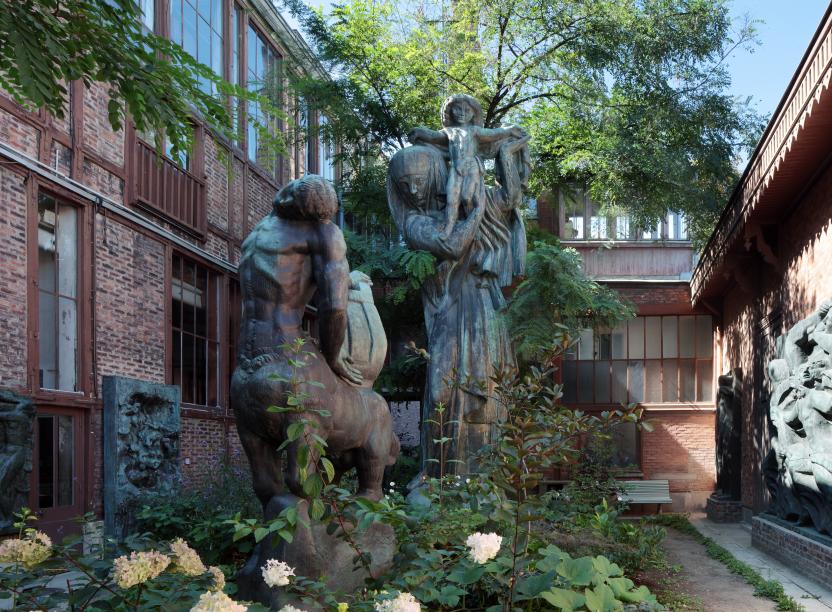
His widow Cléopâtre brings his body back to Paris. She organized a chapel of rest in the sculpture studio, where students, friends, celebrities, and a crowd of strangers came to pay their respects. The setting is sober and imposing; The Dying Centaur as its centerpiece: leaning his head over the coffin, he seems to be mourning his creator. Bourdelle often represents himself as a centaur; he sees in this mythological hybrid being “the spirit mastering matter.” Through a kind of transfiguration, the Centaur now embodies the figure of the master, his presence within the studio.
The sculptor now belongs to Dans le monde de l’âme (In the World of the Soul), the title of a self-portrait drawing in which Bourdelle soars toward the sky, carried by two angels. For him, all creation is an attempt at “escape beyond mankind.”

Final Works, Last Witnesses
[The sculpture studio]
From the winter of 1928 onward, Bourdelle’s health deteriorates; illness keeps him from large-scale commissions and forces him to model works of more modest dimensions. Weakened after the inauguration of the Monument to Adam Mickiewicz in April 1929, he left for Le Vésinet (Yvelines), to the property of his friend, the foundryman Eugène Rudier. He dies there on 1 October 1929.
All witnesses agree that, despite his physical exhaustion, his creative ardour did not diminish, as if he were hurrying to throw his ideas into clay before death interrupts him. In Le Vésinet, Bourdelle creates an entire population of small statuettes, a selection of which is presented around the cast of the right hand that models them. This cast taken “from life,” is made on 24 September, one week before his death.
His last modelled Self-Portrait is undoubtedly created with the assistance of his wife Cléopâtre. Symbolically, Bourdelle also represents himself as Asclepius, the Greco-Roman god of medicine, and as the Rider of the Chimera, that dream which carries him toward creation.

Dossier de presse "Bourdelle. La mémoire des objets" (PDF - 1.1 Mo)
A découvrir


Don't miss any news from the Bourdelle Museum.
Subscribe to our monthly newsletter